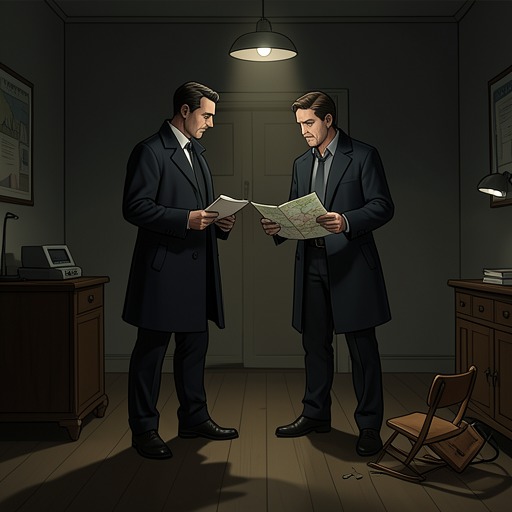
Judah Loeb–Charlie friendship and investigative partnership
Here There Is No WhyJudah Loeb and Charlie’s friendship and investigative partnership joins the intimacy of an old friendship to the compromises of an inquiry into Chaim Lerner’s death. Charlie once served as Judah’s self-appointed older brother; years later, as a Jerusalem homicide detective, he recruits Judah to investigate a case he cannot openly pursue. Their work draws on genuine trust and shared history, but Charlie also manipulates that trust, and the investigation ends in a bargain that preserves the mystery rather than publishing what Judah has learned.
Friendship Before the Investigation
Charlie and Judah had lived together in Israel twenty-two years before the investigation. During that year, Charlie acted as the older, more settled friend: he offered Judah advice about Israeli women, reminded him to eat breakfast, and cautioned him about drinking too much Maccabi beer. Judah remembered feeling comfortable taking direction from him from their first meeting. Their roles seemed unchanged when they reunited, even though Judah recognized that he had grown more sophisticated.
When Charlie arrived at Judah’s Jerusalem lodging, he wore an Israeli police uniform and carried a briefcase full of papers. The two men hugged and searched each other’s faces before Charlie turned his attention to the neighborhood and the work. He had never married and had no children. The exchange exposed a difference between them, as Judah had a daughter, Hannah Loeb, and Charlie immediately asked whether she had accompanied him. But their ease together remained: Charlie took over when Judah struggled to find the coffee maker, boiled Turkish coffee, and returned with him to the investigation.
The Case Becomes a Partnership
Judah had first contacted Charlie three years earlier, when he was considering a book about Chaim Lerner and the unanswered questions surrounding Chaim’s death. Charlie encouraged him to pursue the project, claiming that the Jerusalem police had kept the Lerner file open even after twenty years and promising help from his department. By the time they met, Charlie had become the homicide detective he had once hoped to be. The police connection made Judah’s proposal more attractive to his editors, while Charlie saw a way to use Judah’s reporting to pursue a case that powerful local figures could make difficult for him to reopen.
Their investigative habits initially looked complementary. Judah brought a writer’s attention to language and inference; Charlie tested possibilities against witness accounts and police information. When Judah proposed that Chaim might have fallen accidentally from the balcony, Charlie rejected the theory and insisted that the death was murder. He described five neighbors hearing a thump at about seven in the evening, preceded by Chaim’s voice saying a word that sounded like an expression of surprise. Two witnesses placed Michal and Zehava Lerner away from the apartment, and Charlie treated the family’s alibis as grounds to eliminate them from consideration.
Charlie’s account of the case soon widened beyond the witnesses. He drew Judah’s attention to Meir Alon and Rabbi Kaplowitz, powerful figures who, according to Charlie, had motive and opportunity but had not been properly questioned. Judah challenged the implications of that claim: if these men had admitted Chaim had to die, why had no one interrogated them before? Charlie revealed that he had brought Judah to Jerusalem precisely because he needed an outsider to apply pressure. He had not, as he had implied, learned that the police had reopened the case. The case was closed; Charlie had told Judah otherwise so that Judah would persuade his agent and editors to support the trip.
Trust, Deception, and a Proposed Method
Charlie’s deception did not cancel the friendship, but it changed what the friendship could safely mean. He had investigated Chaim’s enemies after Judah first mentioned the possible book, using his own police connections to approach Alon and Rabbi Kaplowitz. Their accounts stunned him, and he decided that Judah was the person who could bring the matter into public view. His appeal rested on their past closeness, but also on Judah’s profession: a journalist could generate pressure that a detective’s superiors might resist.
When Charlie urged Judah to go home and write, Judah recognized the next part of the strategy. Charlie wanted a fast article that might compel the police to act, after which he could bring his resources to bear and give Judah exclusive access for a book. Charlie admitted that he had left this purpose out of his earlier explanation. Judah proposed a different arrangement: Charlie would open the Israeli files, have important documents translated for Judah and Hannah, and attend further interviews with Alon and Rabbi Kaplowitz in uniform. The presence of a detective, Judah reasoned, could make those meetings resemble the beginning of an official investigation. Charlie had previously suggested that his presence would shut the interviewees down; his willingness to consider Judah’s plan showed how their roles had shifted from recruiter and recruit toward negotiation between collaborators.
The documentary record complicated their theories. Michal said that on the night Chaim died, she was shopping for a wedding dress with Zehava, her future mother-in-law, at Rafik Salahmi’s shop in the Old City. Charlie brought boxes of police records and translated interviews to Judah and Hannah’s cottage, including the receipt. Its time and date supported the alibi. The receipt placed the women at the shop at seven in the evening, while neighbors had reported hearing the fall at about six-thirty. The partnership’s value lay not only in suspicion and access but in checking a dramatic theory against mundane records—and in recognizing when the records made an accusation harder to sustain.
The Friendship’s Moral Limit
As the investigation advanced, Judah concluded that Charlie had constructed a misleading conspiracy narrative. He suspected neither Alon nor Rabbi Kaplowitz had planned to meet or blackmail Chaim that night, and that Chaim’s theology and political statement about the Lebanon War had not motivated a killing. Judah reasoned that Charlie had used those stories to deter pressure for an investigation of Zehava: a publishable accusation without solid proof would be dismissed as biased foreign journalism and could provide a pretext for leaving the case closed. Charlie acknowledged that Judah had understood him. What had begun as a request for help now looked like a plan to control which explanation would become public.
Charlie’s later account confirmed the stakes without offering a legal resolution. Zehava had told Judah she killed Chaim while defending herself, and Charlie said he believed her: Chaim had been cruel and violent toward those closest to him. The account eventually supplied by Michal makes the physical circumstances specific. On the balcony, Chaim attacked her; she tried to push him away, and when he grabbed her injured arm, she shoved him in the chest. He fell backward over the railing and died. The distinction between an intentional murder and a fatal act of self-defense mattered to Charlie, who saw no basis for prosecution, but it did not undo his earlier deception or explain why he had led Judah toward false suspects.
The Deal and Its Aftermath
Zehava asked Judah not to publish the disclosure while she was pursuing a place in government and negotiating with the Palestinian Authority. She warned that exposure could destroy her political standing and damage a fragile prospect for peace. Charlie confirmed both her account of the death and the political importance he attached to her work. He also told Judah that damaging Zehava’s reputation might imperil the peace effort. In the relationship between the two friends, the demand to protect a political possibility became the final test of whether investigative access could be separated from complicity in concealment.
Judah accepted Charlie’s deal. He wrote a book about Chaim but kept the death unresolved, presenting suicide, accident, and murder as possibilities rather than identifying what he had learned. The arrangement restored Judah’s journalism career and gave him access to a secret round of Israeli–Palestinian talks in London. Charlie stayed in Israel, where he was needed in case of renewed terrorist attacks. The talks soon collapsed amid disputes over Jerusalem, refugees, recognition of Israel, Gaza, and Hamas; Judah’s eventual report received little attention. The bargain delivered access and professional recovery, but neither a public accounting of Chaim’s death nor the lasting peace that had been invoked to justify silence.
Charlie’s death ended the partnership. A bomb outside the Russian Compound killed him while he was heading Israel’s police homicide division. By then, the friendship had passed through reunion, investigative collaboration, deception, and a consequential bargain. Charlie had trusted Judah to generate pressure he could not apply himself, while Judah had trusted Charlie’s access and judgment enough to follow the case. Their partnership uncovered the human truth behind Chaim’s fall, but its final product was a book that withheld that truth and an investigation that never became a prosecution.